

If you run a production or distribution line and you're still relying on manual scans, barcodes, or spot-check processes to track what's moving through, there's a better way. This is one of the most common conversations we have with customers who come to us asking about RFID.
Here's a quick breakdown of what RFID actually is, how the Siemens CB Gate puts it to work, and how to know which configuration fits your line.
First: What Is RFID?
RFID stands for Radio Frequency Identification. A small tag (think of a sticker with a tiny chip inside) gets attached to a product, pallet, tool, or container. A reader sends out a radio signal, the tag responds with its ID, and your system knows exactly what just passed through. No line-of-sight scanning, no manual intervention required.
UHF RFID (the frequency range the CB Gate uses) can read multiple tags at once, at distances up to several meters, even when items are moving. That's what makes it well-suited for conveyor lines running at speed.
Yes, pallet scanning, tool tracking, and tire identification in manufacturing. The moment an object breaks the light barrier, reads start automatically. Data flows to your control system via S7 or TCP/IP.
How It Works
Three Configurations to Choose From
All variants ship with a pre-mounted control cabinet, fuses, and light barrier. Frame dimensions: 1.55–1.95 × 2 × 1.2 m · 53 kg. Available in ETSI, FCC, and CMIIT wireless profiles.
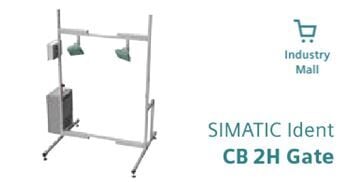
CB 2H Gate
Best when tags consistently face upward. Covers one direction from above using two RF650A antennas.
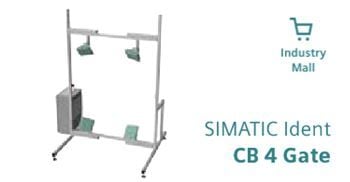
CB 4 Gate
Top and bottom coverage. Integrates into existing operator interfaces. ETSI profile only.
CB 4H Gate
Best when tag orientation varies or can't be controlled. Full multi-directional coverage.
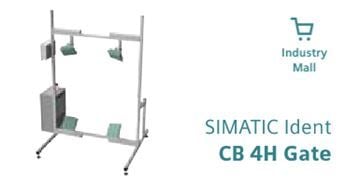
A fourth variant, the CB 4H Gate for Tire, uses the same 4-antenna, top-and-bottom layout but includes specialized algorithms for tire detection, including the ability to distinguish whether a transponder is on the top or bottom side of the tire.
What's in the Box
| Component | Model | Part Number |
|---|---|---|
| CPU | SIMATIC S7-1212C | 6ES7212-1AE40-0XB0 |
| RFID Reader | SIMATIC RF680R | 6GT2811-6AA10-0AA0 |
| Switch | SCALANCE XB005 | 6GK5005-0BA00-1AB2 |
| Power Supply | SITOP PSU6200 | 6EP3334-7SB00-3AX0 |
| Antennas | SIMATIC RF650A (2 or 4) | 6GT2812-0GB08 |
| Control Panel* | SIMATIC HMI TP900 Comfort | 6AV2124-0JC01-0AX01 |
*Included on all variants except the CB 4 Gate (ETSI only, no HMI).
Key Technical Specs at a Glance
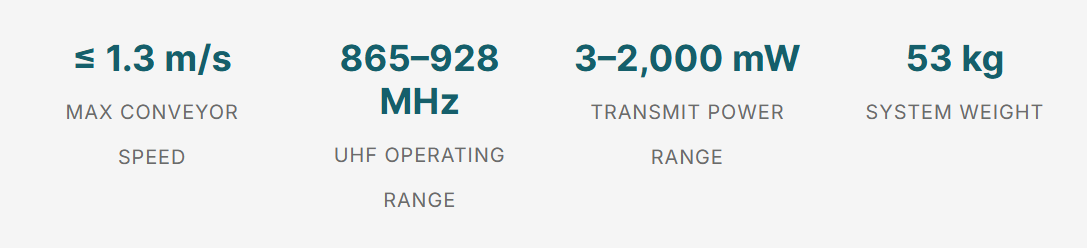
Readable transponder standards: ISO 18000-62, ISO 18000-63, and EPCglobal UHF Class 1 Gen 2. Operating temperature: 0 to +45°C. Supply voltage: 120–264 V AC.
Why It Reduces Engineering Time
The biggest time-sink with RFID projects is typically component selection, antenna layout, and writing base software from scratch. The CB Gate eliminates all three. Predefined TIA Portal function blocks handle identification logic, tag handling, and diagnostics out of the box, so your team focuses on process logic, not low-level RFID handling.
UHF-for-Industry algorithms built into the RF600 reader series keep reads selective within the gate zone, so adjacent tags on nearby lines don't trigger false reads, even in metallic conveyor environments.
Frequently Asked Questions
Do my products already need RFID tags, or does the CB Gate include them?
What happens if two objects pass through at the same time?
Can it read tags regardless of which way the tag is facing?
Does the CB Gate work with our existing PLC or MES?
How fast can objects move through the gate?
Not Sure Which Configuration You Need?
That's one of the most common questions we get.
EandM is an authorized Siemens industrial automation distributor — and a Platinum partner, the highest tier in Siemens' distribution program. We have dedicated Siemens product specialists who work hands-on with these platforms every day and can help you think through your specific configuration before you order anything. We also offer TIA Portal training, hands-on workshops, and free local tech support across the West Coast.