
The SICK deTec4 just got smarter — 6 things it can do now
The deTec4 you already know, paired with the new DCM4 extension module, goes well beyond basic guarding. Here's what changed and why it matters on the floor.
Most safety light curtains do one thing well: they stop the machine when someone breaks the beam. That's the baseline. What engineers have historically had to figure out on their own is everything around that — how to let material through without triggering a shutdown, how to handle tools or fixtures that routinely interrupt the field, how to diagnose a fault at 2am without a laptop and a proprietary cable.
The deTec4 has always been a strong platform. What's new is the DCM4 — a separate extension module from SICK that connects to the deTec4 and unlocks a suite of smart functions the curtain can't perform on its own. Together, they address the workarounds engineers have been building around for years.
deTec4 Safety light curtain — the platform
✓30m scanning range
✓Type 4 · PL e · SIL 3
✓IO-Link + NFC built in
✓Integrated laser alignment aid
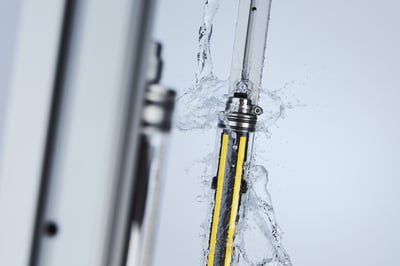
✓IP65/IP67 · –30 to +55°C
New DCM4 Extension module — unlocks smart functions
✓Object pattern recognition
✓Floating + fixed blanking
✓Smart restart interlock
✓Dynamic operating mode switching
✓USB-C via Safety Designer (free)
And more.
1. Object pattern recognition replaces external muting sensors
(Requires DCM4) In intralogistics and material handling, one of the most common setups we see is a light curtain flanked by four muting sensors to let pallets or carts pass while keeping personnel out. It works — but it's wiring, it's hardware alignment, and it's one more thing to troubleshoot. The DCM4 handles object pattern recognition directly. Mount the deTec4 horizontally, program the expected beam-break sequence in Safety Designer, and the system distinguishes that material pattern from a person walking alongside it. No muting sensors required. Works with deTec4 curtains 750mm or longer. (Requires DCM4)
2. Floating blanking for lines running more than one product
Fixed blanking defines a permanent zone where a fixture can sit — useful, but rigid. If that workpiece shifts position, or your line runs more than one product, fixed blanking becomes a reconfiguration project. The DCM4 adds floating blanking: a defined number of beams can be interrupted anywhere along the protective field without triggering a safety output. The system tracks the allowable interruption as it moves — the right tool when material position varies between jobs. (Requires DCM4)
3. Smart restart interlock cuts unnecessary reset steps
Applications where openings need to be monitored to prevent people from entering dangerous areas, a restart interlock of safety light curtain is necessary but sometimes the interruption is so small that it is impossible for a person to have entered that area.\ The DCM4's smart restart interlock changes this. When a small defined object clears the field, the machine restarts automatically without a manual reset. No lost cycles. For high-cycle applications, that's measurable uptime that adds up fast. (Requires DCM4)
4. Dynamic operating mode switching - no restart required
Different parts of a shift may call for different protective field behaviors. With the DCM4, up to four operating modes can be configured and switched between in real time — no machine restart needed. An operator can move between fixed blanking, floating blanking, and advanced reduced resolution on the fly as production requirements change, without stopping the line to reconfigure. (Requires DCM4)
5. IO--Link and NFC diagnostics - built into the deTec4
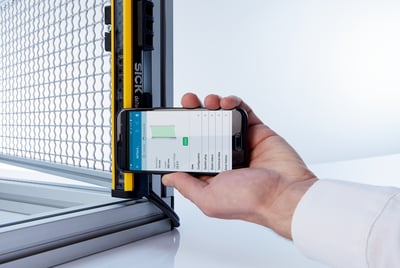
Fault diagnosis on traditional light curtains typically means someone standing in front of the machine with a laptop and the right cable. The deTec4 includes both IO-Link for real-time data integration and an NFC interface for smartphone access via the SICK Safety Assistant app. Diagnostic data, alignment status, and configuration info are readable directly from the device. No connection cable, no software license, no waiting. (Built into deTec4)
6. USB-C configuration — whatever's already in your bag
The DCM4 connects to the deTec4 receiver via M12 8-pin and programs via USB-C using SICK's free Safety Designer software. No proprietary programming cable, no adapter kit to track down. Safety Designer also provides built-in diagnostics, device status monitoring, and service functions — including remote factory reset and laser alignment activation without dismounting the curtain. (Requires DCM4)
DCM4 Technical Specifications
| Safety level | PL e · SIL 3 · Type 4 |
| Enclosure rating | IP65 / IP67 |
| Ambient operating temperature | –30°C to +55°C |
| Connection type | M12 8-pin · SP1 system plug required |
| Configuration | USB-C via Safety Designer (free) |
| Part number | DCM4-AA100A0A0 · 1125888 |
Frequently Asked Questions
What is the DCM4 and how does it relate to the deTec4?
The DCM4 is a separate extension module that connects to a deTec4 safety light curtain and unlocks advanced smart functions — object pattern recognition, blanking options, advanced reduced resolution, smart restart interlock, and dynamic operating mode switching. The deTec4 and DCM4 are specified and ordered separately; the DCM4 is not built into the light curtain.
Can I add the DCM4 to a deTec4 I already have installed?
In many cases, yes. The DCM4 connects to the receiver side of the deTec4 via M12 8-pin connection, using SP1 system plugs (ESP 1200 or 1300). Contact our team to confirm compatibility with your specific variant before ordering.
What's the difference between fixed blanking and floating blanking?
Fixed blanking defines a specific location in the protective field where an object permanently sits — like a conveyor belt running through the field. Floating blanking tracks a defined object that can shift position within the field, useful for cables or parts that move but are always present somewhere in the field.
What software do I need to configure the DCM4?
SICK's Safety Designer software, which is free. The DCM4 connects via USB-C for configuration and also provides diagnostics, device status monitoring, remote factory reset, and laser alignment activation without dismounting the curtain.
What safety ratings does the DCM4 carry?
PL e, SIL 3, Type 4 — matching the deTec4's top safety performance tier. IP65/IP67 enclosure rating, operating temperature –30°C to +55°C.
How does EandM support deTec4 + DCM4 projects?
As the only Elite Gold SICK distributor on the West Coast, EandM provides pre-sale application support to help you select the right configuration, local inventory on both products, and a West Coast-based technical team at no cost. We also offer hands-on workshops and training for teams getting up to speed on the deTec4 + DCM4 platform.
The Only Elite Gold SICK Distributor on the West Coast
Elite Gold is the highest recognition SICK awards to a distributor. EandM is the only West Coast distributor to hold it — meaning deeper product expertise, local inventory, and support you can reach when a project is moving.
Offices in Healdsburg, Walnut Creek, Irvine, Portland, and Seattle. Serving manufacturers, OEMs, and machine builders in CA, OR, and WA since 1955.
SICK Product Specialists on Staff
Presale selection support and application guidance — not just order fulfillment.
Local West Coast Inventory
Stock on hand across CA, OR, and WA — delivery timelines that match your projects.
No-Cost Technical Support
Certified West Coast team at no charge — Safety Designer to field commissioning.
Fast, Accurate Quoting
Slow quotes create real downstream problems. Our inside sales team responds quickly.
Ready to talk through your application?
Talk to an EandM SICK product specialist — we'll work through the selection, confirm inventory, and get you a fast quote.
