Beyond 2D Safety: Adding 3D Visibility with SICK safevisionary2

If you are using 2D safety systems like safety scanners, they do a great job protecting areas on the factory floor. 2D safety systems monitor a flat plane, like a single layer across the factory floor.
But here’s a common issue we see in certain applications: not all hazards stay at floor level.
People reach over barriers. Loads stick out. Robots move in multiple directions.
This is where 2D safety systems start to fall short.
Where 2D Safety Systems Reach Their Limits
Most 2D safety systems monitor a flat plane.
That means:
- They protect feet-level risks very well
- But anything above that plane can go undetected
In real environments, this leads to:
- Unexpected safety gaps
- Nuisance stops
- Reduced productivity
It's not a setup issue; it's a limitation of technology.
Adding 3D Visibility to Close the Gap
This is where the SICK safeVisionary2 comes in.
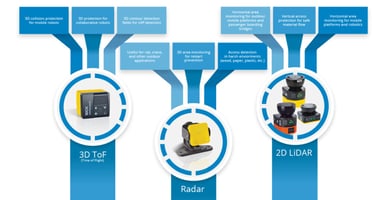
Instead of looking at a flat plane, it monitors a full 3D space around your machine or robot.
That means you can now detect:
- Overhead obstacles
- People reaching or leaning into danger zones
- Drop-offs like stairs or edges
- Movement in all directions
In simple terms: it fills the gap that 2D systems cannot cover.
What Makes It Different
3D Time-of-Flight Technology
It measures distance in real time, so it understands the full environment, not just a line. It works by measuring how long light takes to reflect from objects, allowing precise 3D distance calculation.
Multi-Layer Detection
- Up to ~4 m for safety protection
- Up to ~7.3 m for early warning detection
This allows machines to react early, not just at the last moment.
safeVisionary2 uses different field types:
| Field Type | Function |
|---|---|
| Protective Field | Triggers a safe stop |
| Warning Field | Detects objects early before risk |
| Region of Interest (ROI) | Provides distance data for monitoring and automation |
Field of View
Wide field of view (~68° × 58°) enables broad area coverage.
Dual Safety Outputs (OSSD)
Enables flexible integration and multiple safety signal outputs depending on system design.
More Than Just Safety
It also provides 3D data that can be used for:
- Supporting navigation in mobile robots
- Object detection
- Automation tasks
This means it's not just a safety device; it also adds value to automation and mobile applications.
Built for Real Environments
- No moving parts → high reliability, low maintenance, and consistent performance over time
- Works well in mobile and industrial setups
- Compact and easy to integrate
Where It Adds Value
Mobile Robots (AGVs/AMRs)
Detects obstacles above scanner level and supports collision avoidance.
Robot Cells
Protects upper body movement, not just feet.
Fall Protection
Detect edges, stairs, or drop-offs before it's too late.
Collaborative Applications
Allow safer human-machine interaction with fewer unnecessary stops.
Safety Ratings: PLc vs PLd
safeVisionary2 is a PLc / SIL1 safety device, which means:
- It is typically used to complement higher-rated systems (e.g., PLd scanners) depending on the application risk assessment
- It works alongside them to add 3D visibility
In many applications, the best solution is:
- 2D scanner → primary safety
- 3D camera → additional awareness
A PLd rated 3D solution from SICK AG is expected in the near future.
Note: Like most optical safety devices, both 2D scanners and 3D cameras may not reliably detect transparent objects such as glass or clear materials. These cases should be evaluated during system design.
Conclusion
If your safety system only looks at the factory floor, it's only solving part of the problem.
Adding 3D visibility helps you:
- Improve overall protection
- Reduce unnecessary stops
- Keep operations running more efficiently
It's not about replacing 2D safety, it's about completing it with the right 3D layer.
If you're seeing blind spots in your safety setup, let's review your application and find the right combination of 2D and 3D safety.
Want to learn more about the SICK safeVisionary2? Check out our video here.

.png?height=200&name=1%20(4).png)