
SICK 2D LiDAR vs 3D ToF vs Radar: Which Safety Scanner Do You Need?

I get this question all the time: "Which safety scanner should I use?"
After years of helping customers spec safety scanners in their systems, it comes down to what you're protecting and where. The three main technologies—2D LiDAR, 3D Time of Flight (ToF), and Radar—each excel in different scenarios.
Here are some questions I hear most often:
- "Can this work in dirty and dusty environments?"
- "How can this scanner ignore X material going through?
- "What's best for a mobile application?"
Let’s fully break it down. Here's my go-to reference chart:
Quick Comparison
|
Feature |
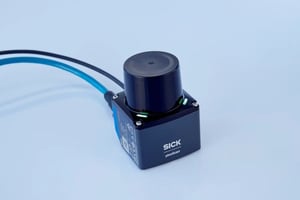
2D LiDAR (microScan3) |
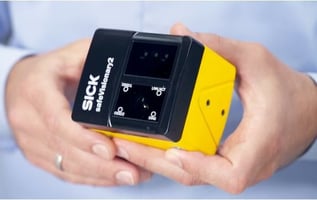
3D ToF (safeVisionary2) |
Radar (safeRS3) |
|
Field of View |
275° horizontal |
68° × 42° |
100° × 20° |
|
Range |
Up to 9 m protective |
Up to 4 m protective |
Up to 5 m protective |
|
Detects |
Hand, leg, body |
Hand, arm, leg, body |
Body |
|
Safety Rating |
SIL2, Cat. 3, PLd |
SIL1, Cat. 2, PLc |
SIL2, Cat. 3, PLd |
|
Fields |
128 total (8 simultaneous) |
24 total (2 simultaneous) |
24 total (4 simultaneous) |
|
Special Ability |
Wide coverage, outdoor capable |
Volume monitoring, spatial depth |
Harsh environments, penetrates materials |
|
Measurement Data |
Yes, up to 64 m via TCP or UDP |
Yes, up to 16 m via UDP |
Detection only |
|
Communication |
I/O, EtherNet/IP, PROFIBUS, EtherCAT, EFI-pro, cIP Safety |
I/O, UDP |
I/O, PROFIBUS |
When to Use Each Technology
2D LiDAR
Best applications:
- Mobile platforms and AGVs
- Perimeter protection with wide coverage (275° is tough to beat)
- Access control for material flow
- Outdoor installations
- Applications requiring extended range
Why it works: The wide field of view provides exceptional flexibility. With 128 configurable fields, you can create complex protection zones tailored to your specific needs.
Limitations: Limited to 2D plane, optical technology not best for harsh environments.
3D ToF (Time of Flight)
Best applications:
- Collaborative robots
- 3D collision avoidance for mobile robots
- Cliff and contour detection
- Applications requiring spatial depth information
- Close-range volume monitoring
Why it works: It monitors three-dimensional space. When you need to know where something is in 3D space—not just that it crossed a plane—this is your solution.
Limitations: Only up to PLc, small range compared to 2D LiDAR vs. Radar.
Radar
Best applications:
- Harsh environments with dust, rain, or debris
- Detection through materials in an area (wood chips, paper bits, plastic shavings)
- Cranes, rails, and outdoor equipment
- Conditions where optical sensors struggle
- Restart prevention in challenging environments
- Can ignore static objects
Why it works: Radar performs in conditions that can compromise optical sensors. I've seen it maintain reliable detection in environments where LiDAR or ToF sensors would require constant maintenance.
Limitations: Lower accuracy than 2D-LiDAR or 3D-ToF, limited field configuration options.
Communication Options
2D LiDAR: I/O, EtherNet/IP, PROFIBUS, EtherCAT, EFI-pro, CIP Safety
3D ToF: I/O with UDP data transmission
Radar: I/O, PROFIBUS
My Recommendations
Choose 2D LiDAR when you need wide horizontal coverage with maximum configurability and range.
Choose 3D ToF when you're monitoring three-dimensional space and need depth perception for close-range applications.
Choose Radar when environmental conditions are challenging or you need detection through materials.
Not sure which fits your application? Feel free to reach out. Many customers use a combination of these technologies in different zones—each one performing where it works best.
Available Through EandM—Elite Gold SICK Distributor
EandM is the only Elite Gold SICK distributor on the West Coast.
This is the highest level of recognition a SICK distributor can achieve, and it reflects our strong partnership with SICK and our commitment to providing the best support, service, and solutions for your automation needs.
What does this mean to you?
It proves we are the best source for SICK on the West Coast!
- Expert Guidance: Our product specialists help you identify the best solution for your specific application.
- Responsive Support: Our sales team ensures you get fast quotes and that support you need, when you need it.
- Reliable Inventory: We have the stock on hand to deliver what you need right when you need it.
Jean Lim is a SICK Product Specialist at EandM. EandM serves customers throughout California, Oregon, and Washington.

-1.png?height=200&name=Spooky%20newsletter%20header%20%20(6)-1.png)