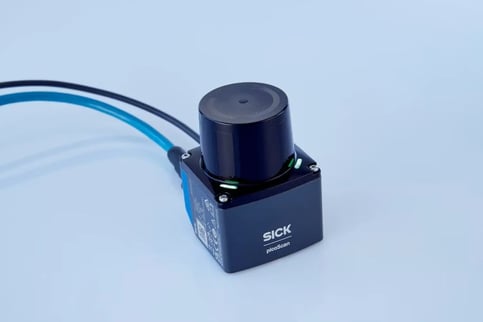
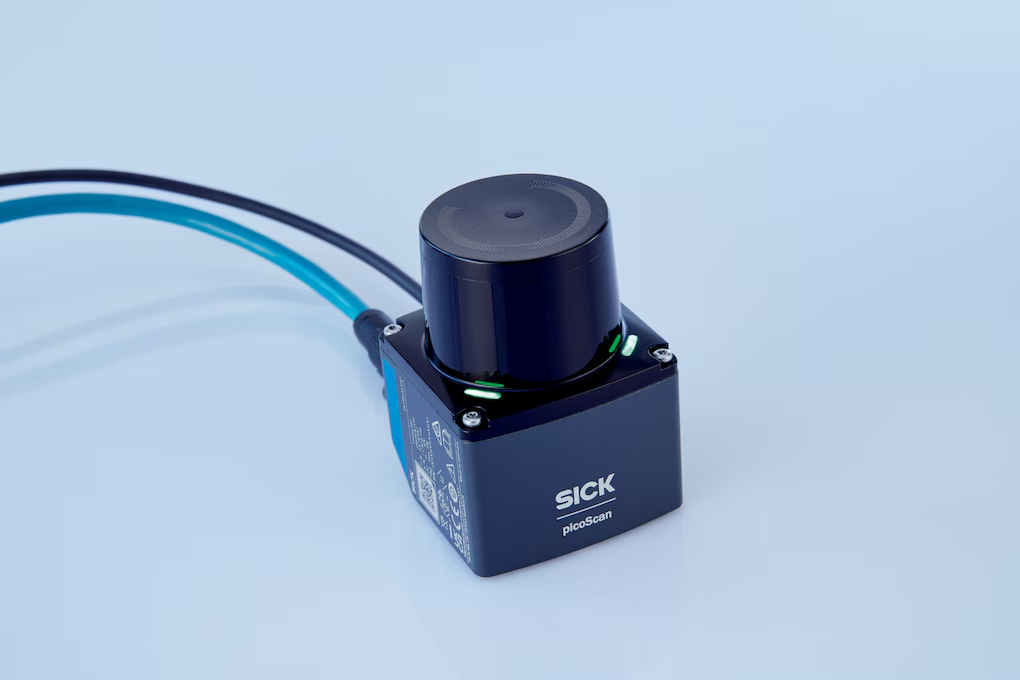
Industrial automation increasingly relies on precise environment sensing to operate safely and efficiently. The new picoScan 2D LiDAR sensor from SICK addresses this need with advanced detection capabilities in a compact, cost-effective package.
What Makes the picoScan Different?
LiDAR (Light Detection and Ranging) sensors use laser pulses to measure distances and create detailed maps of their surroundings. The picoScan150 offers a configurable scanning range that depends on the selected performance profile and the reflectivity (remission) of the target object. Depending on configuration and target properties, scanning ranges of up to 120 meters are achievable. Angular resolution can be configured down to 0.05°, enabling precise object detection and positioning. This enables detection of small objects, with performance depending on distance and surface reflectivity, a critical capability for navigation, collision avoidance, and monitoring applications.
With a 276° scanning field (–138° to +138°), the picoScan150 provides wide-area coverage from a single lidar. For comparison, many competitive sensors require multiple units to achieve similar coverage, increasing both cost and installation complexity.
Three Performance Levels for Different Needs
SICK offers the picoScan in configurations matched to specific application requirements. The picoScan150 includes integrated cables and pre-configured software, making it ideal for indoor mobile robot applications where simplicity matters.
The picoScan150 is available in 3 variants: Core, Prime, and Pro, which offer different maximum range capabilities under specified remission conditions. Depending on target reflectivity and selected performance profile, typical maximum ranges are approximately 25 m, 60 m, and up to 120 m. This tiered approach allows users to select exactly the performance level their application requires without paying for unnecessary capabilities.
Each configuration can be further customized with software features like multi-echo technology, which evaluates up to 3 returned signals per beam to improve measurement reliability. In combination with integrated fog, echo, and particle filters, the sensor can reduce unwanted reflections caused by rain, fog, or airborne particles, making it well suited for outdoor or harsh industrial environments.
Real-World Applications
In autonomous mobile robots (AMRs), the picoScan enables precise navigation and obstacle avoidance. The high-quality measurement data allows robots to create accurate maps of their environment and determine their exact position within those maps.
For industrial vehicles like forklifts, the sensor can monitor blind spots and provide collision warnings. If an object appears in the vehicle's path, the system alerts the operator in time to stop or change direction.
In stationary applications, the picoScan's precision enables tasks like measuring material flows on conveyor systems or detecting the presence of objects on production lines.
Built for Industrial Environments
Unlike consumer-grade sensors, the picoScan150 is designed for demanding industrial environments. Its housing meets industrial requirements for ruggedness, and multi-echo technology, combined with configurable fog, echo, and particle filters, supports reliable object detection even in environments affected by rain, fog, or dust.
The sensor includes contamination detection that monitors the condition of its optical window. This feature enables preventive maintenance - cleaning the sensor before measurement quality degrades rather than waiting for a failure.
Easy Integration and Setup
The lidar supports Compact and MSGPACK data formats via TCP/IP and UDP/IP, as well as native ROS 2 (DDS) communication, enabling integration into robotics and automation systems. The SOPASair web interface allows configuration through any standard web browser without requiring specialized software installation.
For time-sensitive applications, the sensor supports precise time synchronization with other system components, ensuring accurate coordination between multiple sensors or control systems.
Technical Performance That Matters
Angular resolution can be configured from 1° down to 0.05°, and minimum detectable object size depends on distance and resolution, with calculated values down to 2 mm under close-range conditions. These specifications translate to reliable performance in applications requiring precise positioning or object detection.
Select picoScan models operate at scan rates up to 50Hz, providing rapid updates essential for dynamic applications like collision avoidance or high-speed sorting systems.
Conclusion
The picoScan family represents a significant step forward in accessible, high-performance LiDAR technology. By offering configurable performance levels and simplified integration, it makes advanced sensing capabilities available to a broader range of automation applications.
For engineers and system integrators looking to implement reliable environment sensing, the picoScan provides proven technology with the flexibility to match specific application requirements while controlling costs.
Whether the goal is improving safety, enabling autonomous operation, or enhancing process control, the picoScan delivers the measurement performance and reliability that modern automation demands.
To learn more, contact marketing@eandm.com today!