

.png?height=200&name=1%20(4).png)

EandM is the only Elite Gold SICK distributor on the West Coast — the highest recognition SICK...
If you run a packaging or food and beverage line, you've probably seen this: a sensor that works perfectly on opaque containers completely falls apart on clear or transparent bottles. Missed detections. False triggers. Unplanned stops.
It's one of the most common calls we get at EandM and it's not a settings problem. It's a technology problem. Here's what's going on, and how to fix it.
Why Standard Sensors Miss Clear and Transparent Bottles
Most photoelectric sensors work by sending out a beam of light and detecting how much bounces back. Opaque objects reflect reliably. Clear glass and transparent plastic bottles let light pass through instead of reflecting it back, so the sensor either misses the bottle or produces an unreliable signal.
The problem gets worse when you add:
- High line speeds: less time for the sensor to register each bottle
- Curved bottle shapes: scatter light differently than flat surfaces
- Bright plant lighting or glare: interferes with already-weak return signals
- Mixed product runs: lines switching between clear and opaque containers
The result is nuisance downtime, line stoppages, and a lot of troubleshooting time chasing a problem your sensor was never designed to solve.
The Fix: ClearSens Technology on the SICK W16
The SICK W16 product family includes ClearSens technology, which is designed for reliable detection of transparent and clear objects. Unlike standard sensors, it reliably detects glass bottles and clear plastic containers that can be challenging for conventional photoelectric sensors.
On high-speed beverage lines where bottles move continuously and changeovers are frequent, reliable transparent detection becomes critical to maintaining throughput and minimizing unnecessary stoppages.
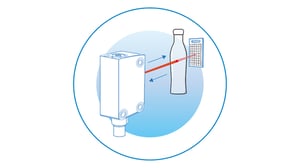
Figure 1: SICK ClearSens technology ensures stable detection of transparent glass and plastic, even with curved surfaces or high line speeds
Here's What Makes it Different
Setup in Seconds: The BluePilot Advantage
Even the most advanced technology is useless if it's too hard to configure. SICK has solved this with BluePilot.
This visual alignment aid allows your team to see exactly when the sensor is optimized. If the bar is full, you’re ready to run. No more trial and error.
Which W16 Variant is Right for Your Application?
The W16 comes in multiple variants. Here's how to choose:
Retroreflective with ClearSens: Best for most transparent bottle applications on packaging lines. One sensor, one reflector, reliable detection of clear bottles breaking the beam. This is the most common starting point.
Through-Beam: Highest sensitivity for demanding applications, very high speeds, thin materials like cling film, or bottles with very low light interaction. Requires a sender and receiver on opposite sides of the line.
Background Suppression (BGS): Best when mounting a reflector isn't practical. The sensor ignores everything beyond a set distance, reducing false triggers from conveyors and backgrounds.
All three are part of the same W16 family, same footprint, same IO-Link v1.1 interface, which simplifies spare parts, training, and troubleshooting across your entire line.
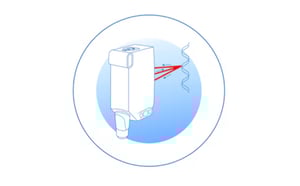
Figure 2: TwinEye technology uses two receivers to reliably detect high-gloss, uneven, or jet-black objects that blind standard sensors.
Built for Real-World Environments
Many W16 variants are available with IP66, IP67, and IP69 enclosure ratings. Combined with the rugged VISTAL housing, W16 is designed to withstand chemical exposure, temperature variations, and mechanical stress commonly found in demanding industrial and washdown environments.
Why IO-Link Makes Day-to-Day Management Easier
Once you've solved the detection problem, you still have to manage sensors across the line. IO-Link v1.1 on W16 lets you change settings and pull diagnostics remotely without stopping production. You get real-time performance monitoring, early warnings before a problem causes a stoppage, and consistent configuration across multiple lines from one location.
For plants running multiple shifts or frequent product changeovers, that visibility saves real time.
Built-In Early Warning: Alarm and Health Outputs
In addition to IO-Link diagnostics, the W16 family includes dedicated Alarm and Health outputs. These provide early warning when detection quality is reduced, for example due to contamination, misalignment, or wiring issues.
Instead of discovering a problem after missing bottles or a line stop, maintenance teams can address it proactively.
Frequently Asked Questions
Bottom Line
If clear or transparent bottles are causing missed detections on your line, the fix isn’t repeated re-adjustments, it’s selecting sensing technology engineered for transparent object detection from the start.
The SICK W16 with ClearSens technology handles transparent bottle detection reliably, across multiple detection configurations, with IO-Link diagnostics to keep things running smoothly.
If transparent bottle detection has been a recurring challenge on your line, let us evaluate your application and recommend the appropriate W16 configuration.
[Talk to a Product Specialist] | [Request the W16 Product Brochure] | [Get a Quote]
.png?height=200&name=image%20(12).png)