

.png?height=200&name=1%20(4).png)
EandM is the only Elite Gold SICK distributor on the West Coast — the highest recognition SICK...
Five Object Detection Challenges and How the SICK W4 Solves Them
This is one of the most common questions we get: "The sensor should be seeing this object — why isn't it working?"
Many jump to the sensor being broken, but mostly the sensor just isn’t tailored to detect the object.
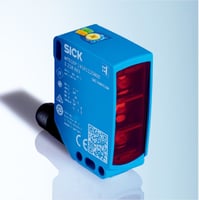
SICK’s W4 sensors are designed specifically for these situations. It's our most versatile miniature photoelectric sensor and as the only SICK Elite Gold Distributor on the West Coast, EandM carries the full W4 lineup and can help you find the right variant fast.
Here are five detection challenges we see all the time, and how a W4 sensor can solve each one.
Challenge 1: Your Object Is Transparent
Clear objects are tough. Light passes straight through instead of reflecting back, which is why standard sensors either miss them entirely or trigger falsely.
What we're talking about:
- Glass bottles and vials
- PET containers
- Transparent plastic film and packaging
- Water or alcohol-filled vials in pharma applications
How the W4 handles it:
The W4 ClearSense retro-reflective models are purpose-built for transparent detection, able to see the slight dimming of its receiving light beams when clear objects pass the W4’s line-of-sight. It reliably detects highly transparent films, glass panes, filled bottles, and clear trays — up to a 7 m sensing range, with best performance between 0 and 5 m.
Challenge 2: Your Object Has Holes, Grooves, or Perforations
When a standard sensor's light spot lands in a hole, it loses the object and sends a false off-signal to your PLC. That means missed counts, nuisance faults, and time spent chasing a problem that's really just a sensor-object mismatch.
What we're talking about:
- Cut semiconductor wafers
- Server chassis and enclosures
- Conveyor grating
- Any object with recesses, grooves, or irregular surfaces
How the W4 handles it:
The W4 DoubleLine is the only sensor in SICK’s portfolio with this capability. It projects two parallel line-spots at the same time. This background-suppression sensor sends a signal once both line-spots detect the object, and only drops the signal once the object leaves both line-spots. This gives you continuous and reliable output from leading edge to trailing edge of your wonky and/or perforated object.
- Sensing range: up to 150 mm
- Best performance: 50–90 mm
- No mechanical workarounds needed
Challenge 3: Your Environment Requires Washdown
Most miniature sensors top out at IP67. That's fine for splash resistance — not fine for the high-pressure, high-temperature cleaning cycles in food and beverage production.
What we're talking about:
- Food and beverage processing lines
- Dairy, meat, and beverage facilities
- Any application with regular sanitizing or chemical wash cycles
How the W4 handles it:
The W4 is available in INOX Wash-Down and Hygienic Design variants with IP69K-rated stainless steel housing. Available as through-beams, retro-reflective, and diffuse models. Same compact miniature footprint — now built to survive the cleaning cycle.
Fewer sensor replacements. Less unplanned downtime.
Challenge 4: Your Object Is Glossy or Highly Reflective
Highly reflective surfaces can overwhelm a standard sensor's receiver, causing it to saturate and misread or skip the object entirely.
What we're talking about:
- Smartphone displays and screens
- Solar cells
- Polished metal parts
- Glossy packaging
How the W4 handles it:
The W4 V-Optic variant is specifically designed for high-reflectivity detection. These sensors send an angled beam of light instead of a straight beam, allowing the sensor to receive much more reflected light when detected objects hit the beam.
Challenge 5: Detecting tiny objects or detecting through small holes
Some processes need sensors to pass through small windows to detect their target, with many having light-spots that get too wide at certain distances for them to pass through these small windows. Sometimes you also need to detect incredibly small targets, like small electronic chips on a PCB.
What we're talking about:
- Fine-positioning in processes
- Multi-conveyor systems with sensors side by side
- Small PCB parts
How the W4 handles it:
The W4's Narrow Beam models can detect objects down to 0.1 mm in diameter thanks to its laser-like LED and incredibly small light-spot. Narrow Beam models have light-spots that can only get as large as 4mm in diameter, allowing the sensors to be mounted right next to each other with little worry of their light-spots crossing/interfering.
One Sensor Family. Five Solved Problems.
No other miniature photoelectric sensor family covers this range of applications. That's what makes the W4 the go-to choice when the detection problem is anything but straightforward.
As EandM's SICK Product Specialist, this is the sensor I recommend most often — not because it's the newest thing, but because it consistently solves problems that other sensors can't.
Have a detection challenge you're trying to work through? Reach out — this is exactly the kind of thing we work on every day.
Ready to see which W4 fits your application? Check out our videos on some of SICK's W4 options.
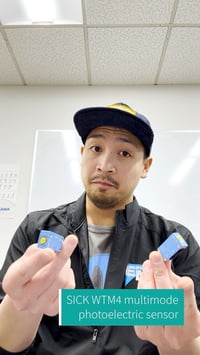
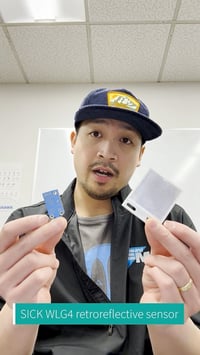
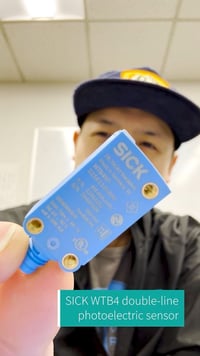
Get a quote or schedule some time with one of our product specialists.
Available Through EandM—Elite Gold SICK Distributor
EandM is the only Elite Gold SICK distributor on the West Coast.
This is the highest level of recognition a SICK distributor can achieve, and it reflects our strong partnership with SICK and our commitment to providing the best support, service, and solutions for your automation needs.
What does this mean to you?
It proves we are the best source for SICK on the West Coast!
- Expert Guidance: Our product specialists help you identify the best solution for your specific application.
- Responsive Support: Our sales team ensures you get fast quotes and that support you need, when you need it.
- Reliable Inventory: We have the stock on hand to deliver what you need right when you need it.
Jean Lim is a SICK Product Specialist at EandM. EandM serves customers throughout California, Oregon, and Washington.

.png?height=200&name=image%20(12).png)